
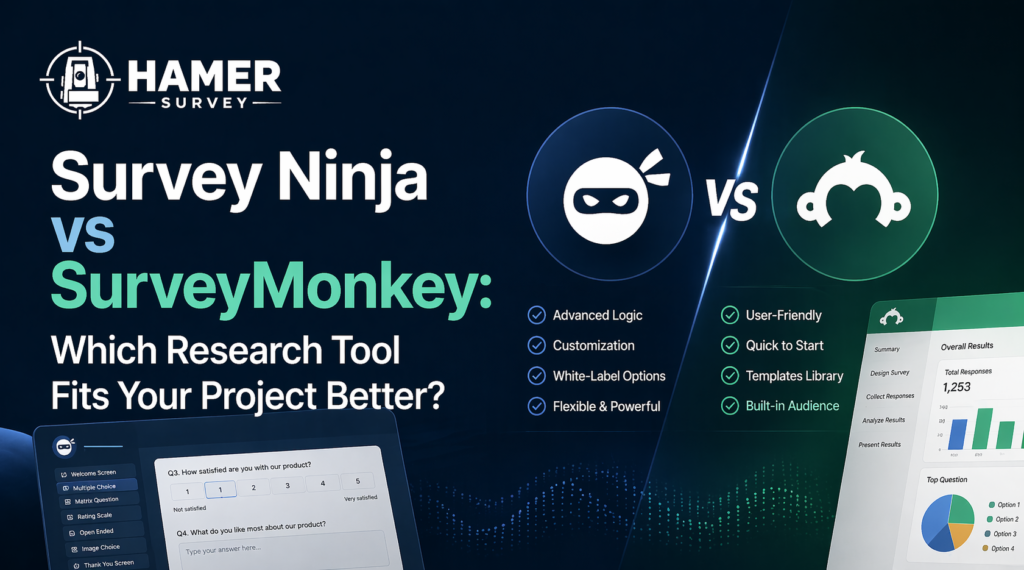
When businesses start a research project, they often ask which survey platform is better. In practice, that is usually the wrong place to begin. A more useful question is which platform fits the project itself.
At Hamer Survey, we work with both Survey Ninja and SurveyMonkey because research projects rarely need the exact same setup. Some studies need speed, a lighter survey flow, and a simpler respondent experience. Others need more structure, deeper logic, or a framework that feels more established for repeated or more formal research work. Survey Ninja is described in independent coverage as a contemporary, user-friendly survey builder for collecting feedback quickly and interactively, while SurveyMonkey positions its platform around survey logic, branching, and more structured respondent paths.
Why the Difference Matters
A survey tool does more than collect answers. It shapes how comfortable the experience feels for respondents, how complex the questionnaire can become, and how manageable the project is for the team running it.
That matters because not every research problem looks the same. A quick customer feedback check after a service interaction is very different from a multi-segment message test or a recurring study that needs consistent structure across time. When the platform fits the task, the research process becomes smoother and the findings tend to be more useful.
When Survey Ninja Makes More Sense
Survey Ninja is often a strong fit when the research project needs to be more agile and respondent-friendly. The independent review of the platform highlights its easy-to-use interface, customizable templates, quick data collection, integrations, advanced analytics, real-time reporting, conditional logic, multilingual support, and offline mode.
That combination makes it especially useful for focused customer feedback studies, satisfaction surveys, shorter market checks, and projects where keeping the experience simple can help completion rates. The same review also notes that Survey Ninja supports multiple survey types, interactive question formats, and integrations with tools such as Google Sheets, Mailchimp, and Slack, which can make it easier to fit into faster-moving workflows.
For businesses that want to launch a study without building an overly heavy process around it, Survey Ninja can feel like the more natural option. It is often better suited to situations where speed, ease of response, and a cleaner survey path matter more than building a highly layered research structure.
When SurveyMonkey Is the Better Fit
SurveyMonkey usually makes more sense when the study itself requires more controlled structure. SurveyMonkey’s official materials emphasize advanced survey logic, including branching and customized respondent paths, which is especially helpful in projects where different answers need to trigger different question flows.
This becomes important in research that involves more segmentation, more formal question routing, or repeated projects where consistency matters. In those cases, the platform is not just a container for the survey. It becomes part of the research design.
There is also a familiarity factor. SurveyMonkey is a widely recognized name, and for some businesses that matters operationally. Teams may already know the environment, feel more comfortable reviewing work inside it, or prefer using a platform they have encountered before. Even broader public perception around the company can influence that familiarity, which is part of why some decision-makers still look at pages like these SurveyMonkey company reviews before feeling comfortable with the name behind the tool.
The Best Choice Depends on the Research Question
The most practical comparison is not “Survey Ninja versus SurveyMonkey” in the abstract. It is which one fits the kind of question the business is trying to answer.
If the goal is to launch quickly, reduce friction, and gather focused feedback through a lighter survey experience, Survey Ninja may be the stronger fit. If the project needs more structure, deeper respondent routing, or a more formal survey framework, SurveyMonkey often becomes more appropriate. Survey Ninja’s reviewed feature set supports that lighter, more flexible positioning, while SurveyMonkey’s official materials clearly emphasize logic and controlled paths.
That is why, at Hamer Survey, we do not treat the tool as the starting point. We start with the decision the business needs to make. Once that is clear, it becomes easier to decide whether the project needs an agile survey setup, a more layered structure, or a combination of survey input with other behavioral and marketing signals.
Final Thoughts
Survey Ninja and SurveyMonkey can both be useful research tools. They simply support different kinds of projects more naturally. One tends to work well when speed, usability, and respondent ease matter most. The other tends to be stronger when the study requires more structure and more deliberate logic handling. Survey Ninja’s reviewed capabilities include real-time reporting, branching, multilingual support, and offline collection, while SurveyMonkey’s official positioning focuses heavily on survey logic and customized respondent paths.
The smartest comparison is not about choosing the most famous platform or the newest one. It is about choosing the one that best supports the research problem in front of you.