
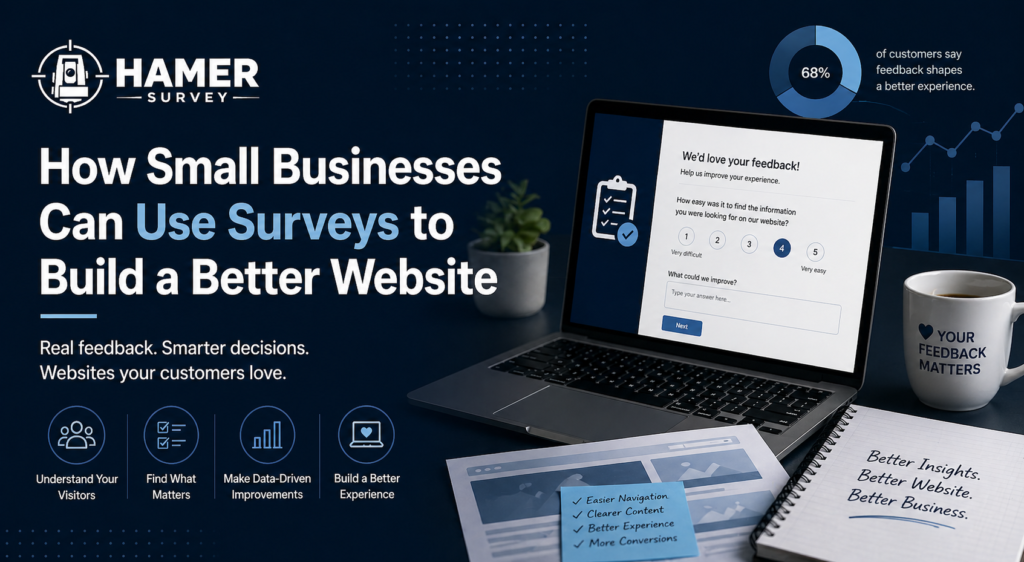
A small business website is often built with good intentions. The owner wants it to look professional, explain the company’s services, and encourage visitors to get in touch. But once the website is live, a common problem appears: visitors come to the site, but not enough of them call, book, request a quote, or make a purchase.
When this happens, many businesses assume the website needs a new design. Sometimes it does. But often, the real issue is not the design itself. The issue is that the website does not answer the right questions, remove the right doubts, or guide visitors clearly enough toward the next step.
Surveys can help small businesses find out what is missing.
Instead of guessing why people leave a website, what information they expected, or what made them hesitate, a short survey can provide direct insight from real customers and prospects. These insights can help a business improve page structure, website copy, trust signals, contact options, and even the platform used to manage the site.
A survey does not need to be complicated. For many small businesses, the most useful feedback comes from simple patterns: people could not find pricing information, did not understand the service process, wanted to see reviews, expected online booking, or needed clearer proof that the company was trustworthy.
The purpose of a survey is not to collect opinions about whether people “like” the website. The purpose is to understand what helps or prevents visitors from taking action.
Surveys Turn Website Problems Into Clear Priorities
Without feedback, website improvement can feel like guesswork. A business may change colors, rewrite headlines, replace images, or move buttons around without knowing whether those changes address the real problem.
Surveys help identify priorities.
For example, if customers say they were unsure what services were included, the priority is clearer service pages. If people say they wanted to compare pricing, the priority is pricing guidance or a quote explanation. If visitors say the business looked credible but they were not sure how to start, the priority is a stronger call to action.
This matters because small businesses usually have limited time and budget. They cannot afford to rebuild everything without direction. Survey feedback helps separate cosmetic preferences from business-critical improvements.
A website may need a full redesign, but it may also need something simpler: a clearer homepage, a better FAQ section, stronger testimonials, a shorter contact form, or a more visible booking button.
Surveys help show the difference.
What Surveys Can Reveal About Website Visitors
Surveys are valuable because they show the gap between what the business thinks it is communicating and what visitors actually understand.
A business may believe its services are obvious. Visitors may find them confusing. A business may think its contact form is simple. Visitors may feel it asks for too much information. A business may assume reviews are not necessary. Customers may say reviews are the first thing they look for.
Surveys can reveal several important types of insight.
They can show what information visitors expected to find but did not see. They can reveal which parts of the website felt unclear. They can identify which trust signals matter most. They can show whether visitors prefer phone calls, forms, booking tools, or messaging. They can also reveal whether the website feels modern, credible, local, accessible, and easy to use.
For small businesses, these details matter. A visitor may leave not because they dislike the business, but because the site creates too much uncertainty. Surveys help uncover that uncertainty before it becomes lost revenue.
Using Survey Feedback to Improve Website Content
One of the fastest ways to improve a website is to improve its content.
Small business websites often use broad phrases like “quality service,” “reliable solutions,” or “customer-focused approach.” These phrases may be true, but they do not always answer what visitors need to know.
Survey feedback helps make content more specific.
If customers repeatedly mention fast response time, that should appear in the website copy. If people value transparent pricing, the website should explain how pricing works. If visitors are concerned about experience, the site should highlight years in business, project examples, or relevant credentials.
The goal is not to overload the website with text. The goal is to replace vague claims with useful information.
A stronger service page does not just say what the business offers. It explains who the service is for, what problem it solves, what the process looks like, what customers can expect, and how to take the next step.
Survey feedback can also improve headlines. Instead of writing from the company’s point of view, the website can reflect the customer’s goal. That makes the site feel more relevant and easier to trust.
Using Survey Feedback to Improve Website Structure
A good website structure helps visitors move naturally from interest to action.
Survey results can show whether the current structure supports that journey or creates friction. If visitors struggle to find key information, the issue may be navigation. If they understand the service but do not take action, the issue may be the call to action. If they visit several pages but still hesitate, the issue may be missing trust signals.
For many small businesses, survey feedback leads to practical structural improvements.
A business may add a dedicated services page instead of listing everything briefly on the homepage. It may create a testimonials section near the contact form. It may add a “How It Works” block to explain the process. It may move contact options higher on the page. It may create a separate landing page for the most important service.
These are not random changes. They are improvements based on how visitors make decisions.
The best website structure is not the most creative one. It is the one that makes the customer journey easier.
Featured Platform Block: Choosing a Website Builder Based on Survey Insights
Survey results can also help small businesses choose the right website platform.
A platform should not be chosen only because it is popular or because a template looks attractive. It should be chosen because it supports the kind of website your customers need.
For many small businesses, specialized website builders are a practical solution because they make it possible to create, edit, and improve a professional website without managing a complex custom development process.
Two useful examples are Wix and uKit.
Wix is a strong option for businesses that need flexibility and room to grow. If survey feedback shows that visitors want richer content, online booking, frequent updates, a blog, a portfolio, or a more polished visual presentation, Wix can be a good fit. It gives small businesses more control over design and content while still being manageable without deep technical knowledge.
Wix may work especially well for consultants, creative professionals, restaurants, studios, local service businesses, and companies that want to build a stronger brand presence over time.
uKit is a practical option for businesses that need a simpler, service-focused website. If survey feedback shows that customers mostly want clear service information, reviews, basic project examples, contact details, and a quick way to request a quote, uKit may be enough. It is suited for straightforward business websites where clarity and speed matter more than complex features.
uKit may work well for local service providers, small firms, repair and maintenance companies, construction-related businesses, and independent professionals who need a clean online presence without extra complexity.
The key lesson is simple: choose the platform after you understand the website’s job.
If customers need more interaction, content, and flexibility, Wix may be the better choice. If they need a simple and clear business site, uKit may be more efficient. The best website builder is the one that helps remove the barriers your survey uncovered.
Surveys Can Improve Calls to Action
A call to action is one of the most important parts of a small business website. It tells visitors what to do next.
But not every audience wants the same next step. Some people want to call immediately. Others prefer to fill out a form. Some want to schedule online. Others want to request pricing first.
Surveys can help identify which action feels most natural to the audience.
For example, a busy homeowner may prefer a short quote request form. A professional services client may prefer scheduling a consultation. A restaurant visitor may want online reservations. A local shop customer may want directions, store hours, or product availability.
This insight can improve buttons, forms, contact sections, and page flow.
Instead of using generic buttons like “Submit” or “Learn More,” a business can use clearer actions such as “Request a Quote,” “Book a Consultation,” “Schedule Service,” or “Check Availability.”
A better call to action reduces uncertainty. It helps visitors understand exactly what will happen next.
Surveys Help Build Trust Where It Matters Most
Trust is not created by one element. It is created by many small signals working together.
Surveys help identify which trust signals matter most to a specific audience. Some visitors want reviews. Others want credentials. Others want photos of completed work, a clear process, service guarantees, local experience, or team information.
This matters because many websites place trust elements in the wrong places. Testimonials may be hidden on a separate page. Certifications may appear only in the footer. Project examples may be hard to find. A strong guarantee may not be visible until the visitor has already lost interest.
Survey feedback helps place trust signals where they support decisions.
A testimonial near a contact form can reduce hesitation. A project example on a service page can make the offer more believable. A short process explanation can make the business feel more professional. A local service area section can reassure visitors that the business works in their community.
For small businesses, trust should be visible, specific, and connected to the customer’s decision-making process.
How to Collect Useful Survey Feedback Without Overcomplicating It
Small businesses do not need a large research program to benefit from surveys. The process can be simple.
The easiest approach is to ask recent customers for feedback soon after they have interacted with the business. Their experience is still fresh, and they are more likely to remember what they needed, what they checked, and what influenced their decision.
Feedback can be collected through email, a short online form, social media, a follow-up message, or a quick conversation after a completed service. The format matters less than the consistency of the information collected.
The most useful surveys are short, focused, and connected to decisions the business is ready to make. A business should not ask for feedback just to collect data. It should ask because it is prepared to improve the website based on what it learns.
Once responses come in, the business should look for repeated themes. One person’s opinion may be useful, but repeated patterns are more important. If several customers mention the same confusion or expectation, that is a strong signal that the website should change.
Turning Survey Patterns Into Website Improvements
The real value of surveys comes from turning feedback into action.
If visitors say the website feels unclear, simplify the homepage and service descriptions. If they say they want to see proof of work, add project examples or case studies. If they say they are unsure about cost, explain pricing factors or the quote process. If they say they prefer online scheduling, add a booking option. If they say they want faster answers, improve the FAQ or add clearer contact information.
The best approach is to treat the website as something that improves over time.
Small businesses often think of a website as a finished project. But customer expectations change, services evolve, and competitors improve. Surveys provide a simple way to keep the website aligned with real customer needs.
This is another reason website builders can be useful. Platforms like Wix and uKit make it easier for small businesses to update content, adjust pages, add testimonials, publish new information, and test improvements without starting from zero each time.
A website that improves regularly is often more effective than a website that looks impressive on launch day but never changes.
Common Survey Mistakes to Avoid
Surveys are most useful when they are focused. A common mistake is asking for general opinions instead of decision-making insight. “Do you like our website?” may produce vague answers. More useful feedback focuses on clarity, trust, missing information, and ease of action.
Another mistake is treating every response equally. A single opinion should not completely change a website strategy. Repeated patterns matter more.
Some businesses also ask too many people who are not part of the target audience. Feedback from friends or internal team members can be helpful, but it should not replace feedback from real customers.
Another mistake is collecting feedback too late. Surveys are helpful after a website is live, but they are also useful before a redesign, before choosing a platform, or before creating new pages.
The biggest mistake is doing nothing with the results. Surveys should lead to decisions, not just reports.
Conclusion: Better Feedback Builds Better Websites
A strong small business website is not built only from design trends or owner preferences. It is built from a clear understanding of what customers need to see, understand, and trust before they take action.
Surveys give small businesses a practical way to collect that understanding. They can reveal missing information, confusing pages, weak calls to action, trust gaps, and platform needs. They can also help prioritize improvements so the business spends time and money where it matters most.
Wix and uKit can both be useful tools for building business websites, but the better choice depends on what the website needs to do. Survey feedback helps make that choice clearer. Wix may be better for businesses that need flexibility, content growth, booking, and stronger visual presentation. uKit may be better for businesses that need a simpler, service-focused website with clear pages and easy contact options.
The most effective websites are not just designed well. They are informed by the people who use them.
Suggested CTA
Planning to build or improve your small business website? Start with feedback from the people who matter most. Social Venues helps organizations use surveys, research, and community insight to make smarter digital decisions.